Best data-only & tablet plans
Data-only SIMs for tablets, hotspots, and connected devices — no phone line required. We compare them at their true monthly cost, taxes and fees included.
Cell phone plans compared

Also shopping for a new phone?
Compare current deals on the iPhone, Galaxy, and Pixel, then pair one with a plan.




Browse carriers by network
The US has three national networks, run by Verizon, T-Mobile, and AT&T. Most other carriers, including budget brands, operate on one of them, so the geographic coverage you get depends on the network, not the brand name on your bill.










Carriers on the same network share the same towers, so where you get signal matches. What differs: data priority when a tower is congested, perks, and customer support. We note these on every plan card.
Not sure where to start?
Our team breaks down the plans worth considering across every network, budget, and use case.


How to stop overpaying for your cell plan
The typical US family spends $120 to $160 a month on wireless, and plenty pay more than they need to. Four things explain why people overpay. Here’s how to read past them.
Carriers advertise the base price, before the AutoPay discount you may not qualify for, a “recovery fee” of about $2 to $5 per line, and government taxes that vary by state. A $65 plan can land past $90. We show the all-in estimate on every card.
Unlimited plans don’t cut you off, but most slow your data after a monthly priority threshold, especially when the network is busy. Premium tiers raise or remove that cap for more money. In dense areas at peak times, standard-priority data can drop below 1 Mbps.
Visible, Mint, Cricket, US Mobile and others run on Verizon’s, T-Mobile’s, or AT&T’s physical towers, so geographic coverage matches. The tradeoffs: lower data priority during congestion, fewer (or no) retail stores, and usually no phone financing. Weigh those against the price gap.
A plan that costs $85 for one line can fall to $45 to $50 per line across four lines. So a carrier that looks “more expensive” can be cheaper per line for a household. Always compare multi-line pricing. Our cards expand to show 1-, 2-, and 4-line costs.
Before you pick, ask three questions: Does it require AutoPay? Are taxes included? Is there a recovery fee? A $30 plan with $10 in taxes and a $4 fee costs $44, so a $45 all-in plan can be the cheaper choice.
For where you get signal, yes. A smaller carrier that runs on Verizon’s, T-Mobile’s, or AT&T’s network uses the same towers, so your map of dead zones doesn’t change. The one real difference is during congestion: budget customers’ data can be slowed when a tower is busy, which you may notice in crowds or dense city blocks. If your area has solid coverage on a given network today, it’ll have it on any brand using that network.
An MVNO (“mobile virtual network operator”) is a carrier that sells service on a major network’s towers instead of building its own, which is how it charges less. The catches are real but narrow: your data may be slowed before the network’s own customers during congestion, there’s usually no retail store to walk into, and most don’t offer phone financing. For a lot of people the monthly savings outweigh those tradeoffs, but they’re worth knowing going in.
Usually, yes. Most phones from the last few years are unlocked (or can be) and work across all three networks. Two things to confirm: that your phone is fully paid off and carrier-unlocked, and that it supports the new carrier’s bands. Our plan cards flag compatibility, or you can check your phone’s IMEI on the carrier’s site before you commit.
Probably less than you think. If you’re on Wi-Fi at home and work, 5 to 10 GB a month covers normal browsing, maps, music, and social. Heavy video streaming on cellular, regular hotspot use, or little Wi-Fi access is what pushes you toward unlimited. The fastest way to know: check your last few bills, where your current carrier shows your real monthly usage.
Yes, and it’s free. Federal rules guarantee it. One tip: don’t cancel your old service first. Start the switch with the new carrier and let them pull (port) your number over, which usually takes minutes to a few hours. You’ll need your account number and a transfer PIN from your current carrier to do it.
An eSIM is a digital SIM built into your phone, with no physical card to swap, so you can activate a new plan in minutes by scanning a code. Most iPhones from the XS (2018) onward and many recent Android phones support it; some newer US iPhones are eSIM-only. Check Settings for an “Add eSIM” or “Add cellular plan” option, or look up your model to be sure.
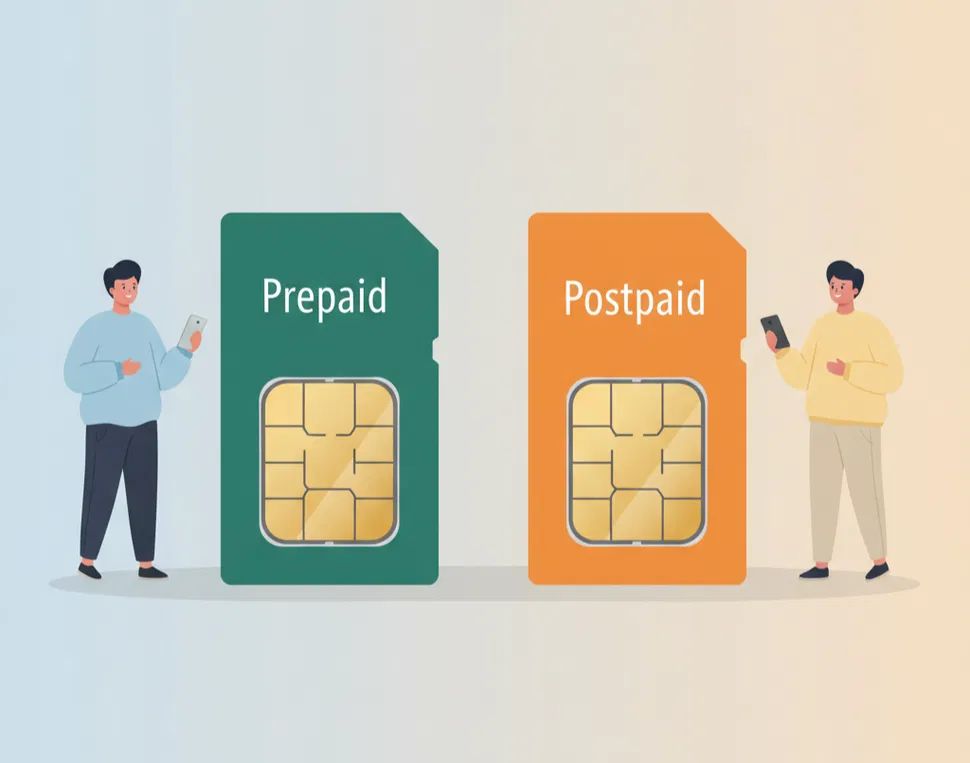
Neither is “better”; they suit different people. Prepaid means you pay up front, with no credit check and no contract, so it’s good for avoiding commitments or capping your spend. Postpaid bills you after the fact, runs a credit check, and tends to bundle perks and phone financing. For the same data, prepaid is often cheaper; postpaid can win if you want a subsidized phone or multi-line perks.
Expect two add-ons beyond the advertised price. First, government taxes and surcharges, which vary widely by state and can add roughly 20% to 30% in many areas. Second, carrier “recovery” or “administrative” fees, usually about $2 to $5 per line. That’s how a $30 plan ends up near $40. We add both into an all-in estimate on every card so you’re comparing real totals.
Not exactly. Unlimited plans won’t cut you off, but most slow your data after a monthly priority threshold, often somewhere between 30 GB and 100 GB depending on the plan, especially when the network is busy. Premium unlimited tiers raise or lift that cap for more money. For most people the standard tier is plenty; heavy users should check the priority-data cap before choosing.
Independent, all-in, and transparent.
To ensure accuracy, this page has been reviewed and fact-checked by Carl Perlas, Jon Stone and Branden S. as part of our editorial review process. Learn how we score.