
Compare US Cell Phone Carriers
See what you'll actually pay at every major US carrier — the advertised price plus the recovery fees and taxes that most plan listings ignore. Almost every budget brand runs on the same towers as Verizon, T-Mobile, and AT&T, so the cheapest phone plan is rarely the one with the biggest ads.
All-in prices fold carrier recovery fees and taxes into a carrier’s cheapest standard single-line plan. Where a plan’s taxes aren’t already in the price, we add an estimated tax and mark the figure with a ~ and “est.” Where a carrier’s fee data is not yet confirmed, it is held out of this ranking rather than estimated.
The Compass Value Score, in plain terms
Every carrier is scored on five things we can verify from published data — not on advertising, and never on who pays us. Value for the dollar carries the most weight, because at identical coverage the price gap between a major carrier and a budget brand on the same network is usually the biggest decision you’ll make.
Read the full methodologySame network, lower price
There are only three real networks. Almost every other carrier rents space on one of them — so a budget brand can give you the exact same coverage for a fraction of what the major carrier charges. If you were about to sign up with a Big 3 carrier, look at its column first.

Same towers as Verizon — identical coverage, lower price.
Verizonoperator from ~$29/mo
Same towers as T-Mobile — identical coverage, lower price.
T-Mobileoperator from ~$13/mo
Same towers as AT&T — identical coverage, lower price.
AT&Toperator from ~$28/moWhat you give up on a budget brand is narrow: your data can be slowed before the network’s own customers when a tower is congested, there’s often no retail store, and most don’t finance phones. Where you get signal does not change.
50 US Cell Phone Carriers & Companies
The complete directory of US phone carriers and companies — major networks and budget MVNOs alike. Filter by network, contract type, or search by name.


Not sure where to start?
Our team breaks down the plans worth considering across every network, budget, and use case.





How to choose a cell phone carrier
Four things decide whether you’re overpaying. Read past the advertising and the choice gets simple.
Carriers advertise the base price, before the AutoPay discount you may not qualify for, a “recovery fee” of about $2 to $5 per line, and government taxes that vary by state. We add all of it into one all-in number, so the price you compare is the price you’ll pay.
Visible, Mint, Cricket, US Mobile and dozens more run on Verizon’s, T-Mobile’s, or AT&T’s physical towers, so your map of dead zones is identical. The tradeoffs are narrow: lower data priority when a tower is congested, fewer (or no) retail stores, and usually no phone financing.
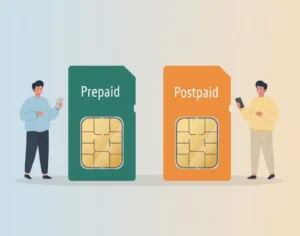
Prepaid means no contract and no credit check, and it’s usually cheaper for the same data — but most prepaid-only carriers won’t finance a phone or run a family account. Postpaid runs a credit check and bills after the fact, but bundles perks and device payments. We tag carriers that are prepaid-only.
Keeping your number is free and federally guaranteed — don’t cancel your old line first, let the new carrier port it. Confirm your phone is paid off and unlocked, and many carriers will cover early-termination or trade-in costs to win the switch.
Figure out which of the three networks covers your home, work, and commute — ask neighbours, or check whose major carrier people around you use. Then pick the cheapest, highest-value brand on that network. You keep the coverage and drop the bill.
It depends on what you weigh most. For pure value, a Verizon- or T-Mobile-network brand like Visible or Mint usually wins — you get the same coverage as the major carrier for roughly a third of the price. If you want premium perks, paid hotspot priority, or the widest rural footprint, the Big 3 still lead. Our ranking sorts every carrier by all-in cost and overall value, so the top of the table is our answer to “best” for most people.
For coverage, yes — an MVNO runs on Verizon’s, T-Mobile’s, or AT&T’s actual towers, so where you get signal is identical to the major carrier it uses. The one real difference is during congestion: budget customers’ data can be slowed when a tower is busy, which you may notice in crowds or dense city blocks. Support and retail presence are usually thinner, too.
Prepaid means you pay up front, with no contract and no credit check — good for capping spend or avoiding commitments, and usually cheaper for the same data. Postpaid bills you after the fact, runs a credit check, and tends to bundle perks and phone financing. Many of the cheapest carriers are prepaid-only, which we tag, because it means you generally can’t finance a phone or run a traditional family account with them.
Yes. Almost every US carrier other than Verizon, T-Mobile, and AT&T buys wholesale access to one (or more) of those three networks rather than building its own. We label the host network on every carrier so you can match coverage you already trust to a cheaper brand on the same towers.
Because the advertised price usually is not what you pay. We add the carrier’s recovery and administrative fees plus estimated state taxes into a single all-in number. Most comparison sites show the sticker price only, which is why a “$30” plan can quietly cost $40. Where we don’t yet have a carrier’s fee data confirmed, we label the figure “Advertised, from $X” rather than guess.
Usually yes on both. Most phones from the last few years work across all three networks once paid off and unlocked — check your phone’s bands against the new carrier’s. Your number is yours to keep, for free: start the switch with the new carrier and let them port it over (don’t cancel the old line first), using your old account number and transfer PIN.
Carriers can't pay for a better ranking.
To ensure accuracy, this page has been reviewed and fact-checked by Carl Perlas, Jon Stone and Branden S. as part of our editorial review process. Learn how we score.