Dumping your current cell phone service provider isn’t always as simple as calling up and cancelling.
If you’re still under contract or owe on a phone financing plan, you might find a nasty surprise on your final bill called the Early Termination Fee.
Early Termination Fees (ETF’s for short) add up…and they can add up fast.
Especially if you have an expensive smartphone or multiple lines.

So What Is an Early Termination Fee Exactly?
When a carrier gives you a discount on a phone or allows you to make payments, they often require a contract in exchange.
In most cases, these contracts are two years long. Carriers use this to ensure that they make back the money they gave you for signing up.
According to Wikipedia:
An early termination fee is a charge levied when a party wants to break the term of an agreement or long-term contract. They are stipulated in the contract or agreement itself, and provide an incentive for the party subject to them to abide by the agreement.
Just because the carrier gave you a shiny new smartphone for $10 doesn’t mean it costs $10. The carrier paid the remaining balance.
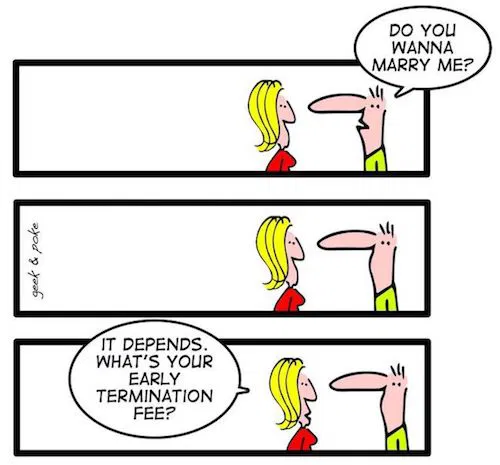
If you cancel service before you contract is up, early termination fees reclaim the money they contributed toward the cost of the phone or other discounts offered to you when signing up.
Fees vary depending on your carrier, account features and other factors. However, most carriers have support pages on the topic or spell out the exact steps for calculating your ETF in their terms of service.
Looking to avoid the number crunching? Call customer support. They must provide you with a total should you want to weigh the cost of leaving your carrier early.
When Do I Need to Pay ETF Fees?
ETF fees most often apply in one of two scenarios:
- You cancel service with your existing provider before you contract is complete.
- You don’t pay your bill long enough that the carrier ends service and your contract.
It’s hard to accidentally incur an early termination fee. But there are rare occurrences (such as an error porting your number between carriers) that might cause an unexpected termination of your service.
In these instances, you might call customer support and work things out.
However, in most cases, once they issue an early termination fee, you’re stuck paying it.
If you don’t, it might impact your credit.
Worse still, they can also blacklist your phone. Then you’re stuck finding a new phone on top of a new provider.
How Much Is The Early Termination Fee?
Your early termination fee depends on the number of lines you have on your account, the phones on your account and sometimes even your monthly service plan.
The government regulates early termination fees in most regions. But despite these regulations, they can still pile up fast.
This is because termination fees apply to each line on your account.
If you have a family plan with 4 lines, you could end up owing hundreds of dollars should you cancel service early.
Current ETF fees for US Carriers include:
| Carrier | Fee | Special Considerations | |
|---|---|---|---|
 | AT&T | $150 for basic phones$350 for smartphones | Basic phone ETFs reduce by $4 for each month of serviceSmartphone ETFs reduce by $10 for each month of service |
 | Boost Mobile | No ETFs | |
 | Consumer Cellular | No ETFs | Remaining amount of device financing is billed to the credit or debit card on file automatically at the time you cancel |
 | CREDO Mobile | $175 for tablets and basic devices$375 for smartphones valued up to $598.99$650 for smartphones valued $599 and greater | Tablet and basic device ETFs reduce by $5 for each month of serviceSmartphone ETFs reduce by $10 for each month of service.Smartphone ETFs reduce by $20 for each month of service. |
 | Cricket | No ETFs | |
 | FreedomPop | No ETFs | |
 | GreatCall | No ETFs | |
 | Metro by T-Mobile | No ETFs | |
 | MintSIM | No ETFs | Prepaid time is non-refundable |
 | Net10 Wireless | No ETFs | Device financing through third-party might result in additional fees upon cancellation. |
 | PagePlus | No ETFs | Device financing through third-party might result in additional fees upon cancellation. |
 | Project Fi | No ETFs | Any remaining device payment fees are due upon cancellation of service. |
 | Republic Wireless | No ETFs | Device financing is subject to terms through Affirm. |
 | Simple Mobile | No ETFs | Device financing through third-party might result in additional fees upon cancellation. |
 | Straight Talk | No ETFs | Device financing through third-party might result in additional fees upon cancellation. |
 | T-Mobile | No ETFs | Device financing and lease fees due at time of cancellation. |
 | Tello | No ETFs | |
 | TextNow | No ETFs | |
 | Ting | No ETFs | Device financing is subject to terms through Affirm. |
 | Total Wireless | No ETFs | |
 | Tracfone Wireless | No ETFs | |
 | Twigby | No ETFs | |
 | U.S. Cellular | $150 for feature phones, modems and hotspots$350 for smartphones and tablets | ETFs for feature phones, modems and hotspots reduce by $3.13 per month of serviceETF for smartphones and tablets reduce by $8.33 per month of service |
 | Ultra Mobile | No ETFs | |
 | US Mobile | No ETFs | |
 | Virgin Mobile | No ETFs | |
 | Verizon Wireless | $175 for basic devices$350 for advanced devices | ETFs for basic devices reduce by $5 per month for months 7 through 17, $10 per month for months 18 through 22 and $30 for month 23.ETFs for advanced devices reduce by $10 per month for months 7 through 17, $20 per month for months 18 through 22 and $60 for month 23. |
 | Xfinity Mobile | No ETFs | Remaining device financing balance due upon service cancellation |
How Can I Avoid ETFs?
The simplest way to avoid ETFs is to avoid contracts.
Instead, buy your phone upfront and choose a SIM-only plan.
It might cost more at first, but by avoiding fees like these, you’ll likely save money over the long term.
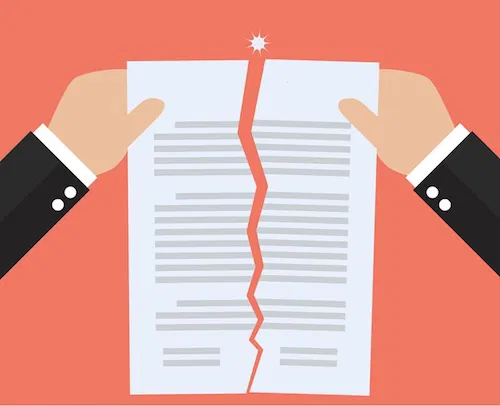
If you recently signed up for a new contract, Carriers must give you a full refund within 14 days of starting service should you want to cancel for any reason. However, you must return any equipment in like new condition if you received a subsidy or lease agreement.
This means you might still have an easy option to get from ETFs before it’s too late.
However, for most readers, you’re probably already on a contract.
If you don’t want to pay it, you can try lowering your plan to reduce your monthly bill and letting your contract finish.
Be sure to check the terms of your contract. If you lower your bill too much, it might not count toward lowering your ETF anymore.
Related Guide:
Getting Out of Your Mobile Phone Contract
While most options won’t work overnight, with a little time, you could find yourself free of your contract and fees.
What About Contract Buyouts?
Some carriers will pay your ETF and device financing balances if you switch to their service. This is known as a contract buyout.
However, buyouts often part of a promotional deal. So options might vary or only be available at certain times.
Even then, some will only pay up to a certain amount in fees. If you’re early in your contract—or have multiple lines—you might find out-of-pocket fees still add up.

You’ll also need to sign a new contract. This means you could find yourself in the same situation should you want to switch again in a few months.
Most contract buyout options, such as the current Verizon Contract Buyout promotion, reimburse you with a prepaid card. This means you’ll either need to let your ETF bill sit until the card arrives or pay the fee out-of-pocket and use the prepaid card elsewhere.
Current options include:
| Carrier | Terms | |
|---|---|---|
| AT&T | Up to $650 toward ETF fees with trade-in of old device, purchase of new device and new line activation. Benefits max out at $350 without a device trade-in. |
| CREDO Mobile | Up to $350 per line and $300 per trade-in as account credit when switching to CREDO Mobile with new two-year commitment. |
| T-Mobile | Up to $650 toward ETF and device payment plan fees across 10 lines with trade-in of old device, purchase of new device and new line activation. |
| Ting | 25% of your ETF refunded, up to $75 per line, with activating Ting service and porting in your number. |
| U.S. Cellular | Up to $650 toward ETFs per line with trade-in of old device, purchase of a new device, activation of select plans, addition of phone protection and porting of your old number. |
| Verizon | Up to $650 toward ETF fees with trade-in of old device, purchase of new device and new line activation. Benefits max out at $350 without a device trade-in. |
Final Thoughts
Early termination fees might be a hassle, but as long as you fulfill the terms of your legal contract, you won’t need to worry about them.
If you’re looking to avoid ETFs, skip the next upgrade your carrier offers and buy a unlocked phone outright. You can find unlocked options on sites such as Amazon that fit the needs of most users for around $100 to $200.
Should your budget allow, we think the upfront expense is well worth the freedom and lack of fees down the road.
P.S. Unless you’re looking for the latest high-end model available, you can save even more buying a used phone.



This has been helpful. Thanks!