


ZTE Axon M
Verdict
If having dual screens is important, the Axon M is one of the best — and only — options available. However, it requires compromising both battery life and portability to achieve it. That trade might not work for everyone.
Key specs
Critic consensus

“Has a unique design that folds out to reveal a second display, effectively transforming the phone into a small tablet, but there are some kinks to work out.”

“Considering the system performance, the Axon M from ZTE is nothing special. But with the second display which can be unfolded, it becomes a real alternative for those to whom the conventional smartphone displays are too small and tablets or notebooks too big.”

“The Axon M is ideal for those moments when you absolutely need to multitask. But most of the time, it's simply not as fast and doesn't last as long, feel as comfortable to use or take pictures as well as similarly priced flagships from Samsung or Google.”

“This isn’t the worst effort ZTE could have made, although it is a bit half-baked, and the Axon M falls short in key areas. Unfortunately, software is the one of the most deficient areas of the M. Simply stretching and splitting content in accordance with the in-built functionalities of the Android OS leaves the user with a rather slapdash user experience.”
Watch before you decide



In Depth
While still not a household name, ZTE has proven it is possible to make a high-end phone with mid-tier prices. With their latest release, they’re diving into uncharted territory.
We usually start by describing a phone’s design. But in this summary, we must start with screens…
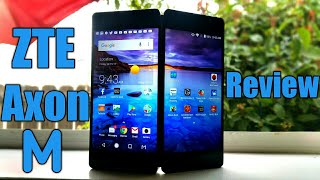
The Axon M sports two 5.2-inch 1080p LCD panels. There is a screen on the front and the back. An aluminum hinge in the middle makes it possible to use the phone in a tablet-like mode or stand it up like a tent.
The panels are both bright and reasonably accurate when it comes to colors. Gorilla Glass 5 coatings on both screens also meant that reviewers had no problems with scratches and scuffs when tossing the phone in their pocket or bag.
That said, the design has its downsides…
The phone is both thick and heavy. Many reviewers likened it to holding a deck of cards. Also, since there are screens on both side of the phone, finding a compatible case is next to impossible.
Lastly, while you can unfold the phone and span content across both screens, this creates a 10.4-inch square display, not a larger rectangle display. So for most content, you’re almost getting more black bars than added space.
The phone uses a 2.15Ghz quad-core Snapdragon 821 with 4GB of RAM. Reviewers had no problem launching two apps or a game and a movie at the same time using each display. The processor had no problem keeping up, and the experience remained fluid — even when reviewers pushed the phone to its limits.
You’ll find a generous 64GB of internal storage for your favorite apps, games, and media. Support for microSD cards up to 256GB means you can expand anytime.
Software changes are minimal, with a few extra buttons and settings to account for the dual displays. Otherwise, you’re greeted with a stock Android 7.1.2 interface and features. ZTE planned support for Android 8.0 — however, exact dates are unavailable.
The camera was a major point of contention among reviewers. The phone sports a single 20MP rear camera. There is no dedicated front lens. If you want to use video chat or take selfies, you’ll need to be sure you’re facing the correct display and use the software to trigger the camera.
Reviewers found this approach clunky and confusing.
However, once they got the camera running the way they wanted, they captured decent pictures. Low-light performance is only so-so, but still acceptable for quick snaps or social sharing images.
With two screens, the 3180mAh battery has quite a range of run times. In single display mode, reviewers had no trouble hitting a full day on a single charge. With both displays running resource-intensive apps, the battery died in roughly 2 hours.
Charging speed was decent, with a full charge taking around 1.5 hours. However, if you’re planning on using the dual display features often, you’ll want to keep a charger nearby.
Reviews on the phone are mixed overall — mostly revolving around the design. This isn’t a slim, trim, flagship device. And if you don’t have an interest in dual displays, there are cheaper single screen options with similar specs.
TechRadar summed up opinions well, saying, “The Axon M is obviously a niche device, and to that niche it delivers something special in a surprisingly polished manner.” Gear Diary was less positive with their verdict, stating, “… as a proof of concept, the ZTE Axon M is fascinating, but it’s too small and too limited by the lack of third-party software to truly be a daily driver.”
What people actually want to know
When was the ZTE Axon M released?
The ZTE Axon M was released on November 17, 2017.
How long does the battery last on the ZTE Axon M?
The ZTE Axon M has a 3,180 mAh battery.
Does the ZTE Axon M support wireless charging?
No, the ZTE Axon M does not support wireless charging.
Does the ZTE Axon M have a headphone jack?
Yes, the ZTE Axon M has a 3.5mm headphone jack.
Does the ZTE Axon M support 5G?
Yes, the ZTE Axon M supports 5G connectivity.
Does the ZTE Axon M have NFC?
Yes, the ZTE Axon M has NFC. You can use Google Wallet, Apple Pay, and tap-to-pair with Bluetooth accessories.
Where can I download the ZTE Axon M manual?
You can view and download the ZTE Axon M manual on our dedicated manual page.
Questions & answers
Have a question about the ZTE Axon M? Ask it here and we'll email you as soon as someone answers. Readers have answered 5,000 questions across PhoneCompass.
Finish the security check above to post your question.
Your name shows with your question.
✓ Question submitted. We'll notify you when someone answers.
We sent a verification link to . Click it to publish your question.
Can't find it? Check your spam folder.
How it compares


New phones, honest scores.
One email when something worth knowing changes. No deal spam, no filler.